Nowhere to Lock Up: How Birmingham's Bike Parking Problem Is Killing the Cycling Commute

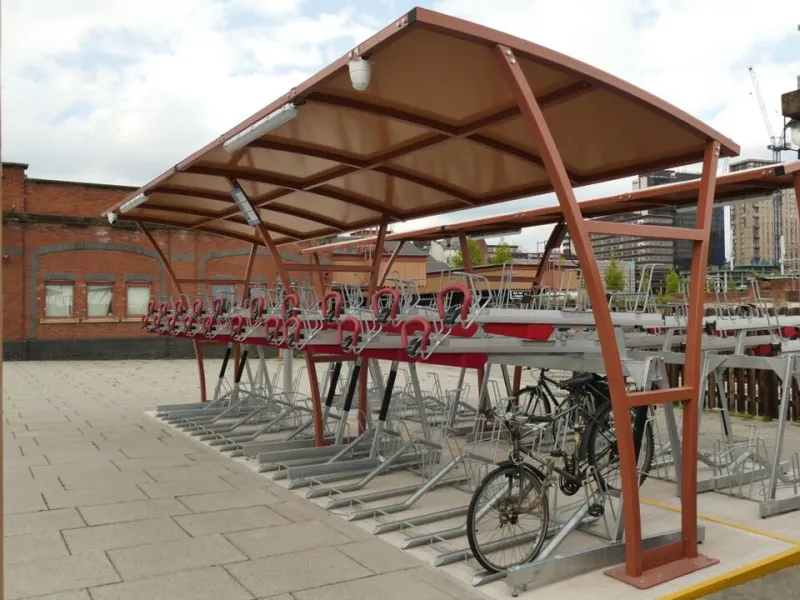
Photo: TheAriAlvarez, CC BY-SA 3.0, via Wikimedia Commons
There's a particular kind of frustration that only cyclists know. You've done everything right. You've committed to the commute, invested in decent kit, and mentally prepared yourself for the school-run traffic on the Pershore Road. Then you rock up to your destination — a train station, an office block, a city centre car park — and the bike storage situation is, frankly, an embarrassment.
A couple of dripping Sheffield stands bolted to a concrete wall. One of them already taken by a rusting skeleton of a bike that clearly hasn't moved since the last World Cup. No shelter. No CCTV. No chance you're leaving your £600 hybrid there while you're on a train to Manchester for the day.
So you turn round. You drive. And Birmingham loses another would-be cycling commuter before they've even started.
The Problem Nobody's Talking About Loudly Enough
When we talk about cycling infrastructure in this city, the conversation almost always defaults to roads — painted lanes, protected junctions, the never-ending debate about who has right of way on the Hagley Road. Bike parking barely gets a mention, and yet it sits right at the heart of why so many people try cycling to work once and never bother again.
Theft is a massive part of this. West Midlands Police recorded thousands of bicycle thefts across the region in recent years, and those are just the ones that get reported. Most cyclists who've had a bike nicked simply absorb the loss, replace it if they can afford to, and ride with a creeping anxiety that never quite goes away. For commuters who need to leave their bike unattended for eight or nine hours, that anxiety is enough to make the car look very appealing.
Sarah, a nurse who works at the Queen Elizabeth Hospital, tried cycling in from Kings Heath for three months last year. She loved the ride itself — twenty minutes through Moseley, a bit of Cannon Hill Park if she timed it right. What she didn't love was chaining her bike to a railing outside the hospital because the designated rack was perpetually full by the time she arrived for an early shift. "I came out one evening and someone had tried to cut through my lock. Didn't get the bike, but it was close. After that I just couldn't face the stress of it."
She's back in her car now. Paying £4.50 a day to park it.
Stations: A Particular Weak Spot
If you want to understand the scale of the problem, spend ten minutes at New Street, Moor Street, or any of Birmingham's suburban rail stations during rush hour. The disparity between car parking provision and cycle parking is almost comical — hundreds of spaces for vehicles, a handful of hoops for bikes, often unsheltered, occasionally vandalised.
Birmingham New Street does have a cycle hub, tucked away and not exactly trumpeted in Network Rail's marketing, but it's a start. The problem is consistency. Commuters who use the Cross-City Line or the Chiltern routes into the city often have a completely different experience at their home station — think a couple of stands in a dark corner of the car park with no lighting and no surveillance.
For anyone considering a "bike and train" commute — widely regarded as one of the most efficient, cost-effective ways to get around a city like Birmingham — this patchwork approach is a serious deterrent.
What's Working Elsewhere
Other UK cities have started treating this seriously. Bristol has been rolling out Bike Hangars — those distinctive on-street pods that replace a single car parking space and provide secure, weatherproof storage for up to six bikes. Residents apply for a key fob, pay a modest annual fee, and suddenly they've got safe overnight parking right outside their front door. Leeds has been expanding its cycle hubs at major rail interchanges. Even smaller cities like Exeter have invested in covered, CCTV-monitored racks at key commuter pinch points.
The common thread? These aren't expensive vanity projects. A Bike Hangar costs a fraction of what it takes to build a multi-storey car park. The return on investment, measured in reduced congestion and improved air quality, is substantial. The political will to prioritise them, though, has historically been lacking in Birmingham.
There are signs that's changing. A handful of Bike Hangars have appeared in Bournville and Stirchley as part of recent active travel schemes, and the feedback from residents has been overwhelmingly positive. The demand for spaces outstripped availability almost immediately — which tells you everything about the unmet need that's been sitting there quietly for years.
The Workplace Piece
It's not just public infrastructure that needs attention. Employers have a role to play here that many are still ignoring. The government's Cycle to Work scheme has made it easier than ever for staff to buy bikes tax-efficiently, but if the office building has nowhere to store them — or worse, asks employees to haul them up three flights of stairs to a cupboard — the scheme's benefits are undermined before they begin.
Progressive employers in Birmingham are starting to get this. Several businesses in the Colmore Business District have invested in proper cycle storage rooms with shower facilities, recognising that it's a genuine recruitment and retention asset. But for every company that's made that move, there are dozens operating out of older buildings where the attitude remains: "there's a railing out front, that'll do."
The comparison with EV charging points is instructive. Businesses have been falling over themselves to install charging infrastructure for electric vehicles — partly because it looks good, partly because there are grants available. Secure cycle parking deserves the same enthusiasm, and frankly the same funding incentives. A bike takes up a fraction of the space, costs a fraction of the infrastructure investment, and produces zero emissions. The logic for prioritising it is overwhelming.
Making the Case
Birmingham has spent the past few years talking a good game on cycling. Active travel strategies, ambitious modal shift targets, promises of Dutch-style infrastructure. Some of it has materialised. A lot of it hasn't. And in the meantime, the gap between cycling rhetoric and cycling reality continues to frustrate the people who are actually trying to pedal to work every day.
Secure, accessible, well-located bike parking isn't glamorous. It doesn't generate the same headlines as a new segregated lane on a major arterial road. But for the commuter standing outside a full, exposed rack at 7am wondering whether their bike will still be there at 6pm, it's everything.
Get the parking right, and you remove one of the last practical excuses for not making the switch. Get it wrong — or just leave it as an afterthought — and you're essentially telling people that cycling is fine in theory, but on your own head be it.
Birmingham can do better than that. It needs to.